Inherited a House in San Diego? How Prop 19 Can Change the Property Taxes, and What That Means for Keeping, Renting, or Selling
I'm Matt. I buy houses for cash around San Diego County, and a lot of the people I talk with have just inherited Mom's or Dad's house. Usually it's a home the family has owned for decades, with a property tax bill that's still surprisingly low. Then someone mentions "Prop 19," and suddenly nobody's sure what the taxes will be.
Here's a plain-English look at how Prop 19 works for an inherited home, and how it plays into deciding whether to keep it, rent it, or sell it.
What changed with Prop 19
Before 2021, parents could usually pass their home (and often other property) to their kids without the property being reassessed. Prop 19 changed that for transfers on or after February 16, 2021.
Now the parent-child exclusion only covers the family home, and only if two things are true:
It was the parent's principal residence, and
It becomes the child's principal residence.
If none of the kids move in, the house is generally reassessed to current market value. That's often a big jump on a home that's been in the family since the '80s or '90s. Rentals and other property no longer get the exclusion.
There's a value cap, too
Even when a child moves in, the exclusion has a limit. For transfers between February 16, 2025 and February 15, 2027, the cap is the home's existing taxable value (its "factored base year value") plus $1,044,586. If the home's market value is above that, the difference gets added to the taxable value.
The math depends on your home's numbers, so I'm not going to guess at yours. The State Board of Equalization walks through examples on its Prop 19 page, and the County Assessor's office can tell you what applies to your property.
Deadlines that are easy to miss
When you're grieving and handling an estate, paperwork slips. Two deadlines matter here:
The homeowners' exemption. The child moving in generally needs to file for the homeowners' exemption (or the disabled veterans' exemption) within one year of the transfer.
The exclusion claim. The claim for the parent-child exclusion is generally due within three years of the transfer, or before the home is transferred to someone else, whichever comes first.
Call the San Diego County Assessor's office early and ask which forms you need.
What if you move in, then move out later?
The exclusion lasts only as long as the home is your principal residence. Once you move out, the BOE says the home gets a new taxable value, at market value, as of the next lien date. So "I'll live there a year and then rent it out" usually means a higher tax bill once you move out.
Your three real options
1. Keep it and live there. If the house works for you and you meet the rules, this can keep the taxes low. Just make sure the filings get done.
2. Keep it and rent it out. This works for some families, but go in with eyes open: the taxes will likely be reassessed, older homes often need work before they're rentable, and being a landlord in California comes with real rules and responsibilities. If you're in the City of San Diego, local tenant rules apply on top of state law.
3. Sell it. For many families, especially when siblings share the house and live in different places, selling is the simplest way to settle things fairly. Whether the home is in La Mesa, Poway, Santee or Lakeside, you can list it with an agent or sell it as-is for cash.
If selling to me makes sense
I buy inherited houses as-is. That means:
No clean-out. Take what matters to your family and leave the rest. I'll handle it.
No repairs. Old roof, original kitchen, foundation questions, it's all fine.
A cash offer within 24 hours of seeing the house.
Close in 7–14 days, or later if the estate needs more time. If the house is in probate, I work with the executor and the estate's timeline. My probate guide covers how that works.
One number for everyone. When there are several heirs, a written offer makes it easier for everyone to agree.
There's no fee and no obligation. If listing makes more sense for your situation, I'll tell you that.
Your next step
Before you decide anything, talk with a CPA about the taxes, including how the home's tax basis works when you sell. Then if you want to see what a cash sale would look like, call or text me at 858-625-1873, or request an offer on my Get My Fair Offer page. For more on inherited homes, see 5 Things to Know Before Selling an Inherited House in San Diego.
This article is general information, not tax or legal advice. Property tax rules are complex and every situation is different. Please check with a CPA, an attorney, or the San Diego County Assessor about yours.
Got a Notice of Default in San Diego County? Your California Foreclosure Timeline, Step by Step
I'm Matt. I buy houses for cash here in San Diego County, and I talk with a lot of homeowners who just pulled a thick envelope out of the mailbox with "Notice of Default" printed across the top. If that's where you are right now, take a breath. A Notice of Default is serious, but it's the start of a process, not the end of it. In most cases you have more time and more options than it feels like on day one.
Here's how the California foreclosure timeline works, in plain English, and what your options are along the way.
What a Notice of Default actually means
Most California home loans are secured by a deed of trust, and most foreclosures here happen without a lawsuit or a judge. The official notice even says so: your property "may be sold without any court action."
A Notice of Default (often called an "NOD") is the document your lender's trustee records with the County Recorder to officially start that process. It says you've fallen behind on the loan and that the lender has chosen to move toward a sale.
The California foreclosure timeline, step by step
1. Before the NOD, your servicer has to reach out. Before a Notice of Default can be recorded, your mortgage servicer generally has to contact you (or make a diligent effort to) to go over your situation and options for avoiding foreclosure. Then it has to wait 30 days. During that contact, they're supposed to give you the HUD phone number for finding a housing counselor.
2. The NOD is recorded. This starts the official clock.
3. At least three months pass. California law requires at least three months between recording the Notice of Default and the next step.
4. A Notice of Trustee's Sale sets a date. After that waiting period, a Notice of Trustee's Sale announces the date, time, and place of the sale. The earliest a sale can legally happen is three months and 20 days after the NOD was recorded.
5. The sale (or a postponement). If nothing changes, the property is sold at a trustee's sale. Sales do get postponed, and if a sale is pushed back 10 business days or more, you're supposed to get written notice of the new date.
Keep in mind those are minimums. Real timelines vary depending on your lender, postponements, and whether you're working on a solution with your servicer. Always go by the actual dates on your own paperwork.
Your right to catch up ("reinstate")
In California you generally have the right to bring the loan current, meaning you pay the past-due amount plus allowed fees and costs, and have the foreclosure called off. That right usually lasts until five business days before the scheduled sale date. If the sale gets postponed more than five business days, the right can come back. You can ask your lender in writing for an itemized statement of exactly what it would take.
Options worth looking at first
Selling isn't always the right answer, and I'd rather you look at everything before deciding:
Catch up (reinstate). If you can pull the money together from savings, family, or a new job, reinstating keeps you in your home.
Ask your servicer about a loan modification, repayment plan, or forbearance. Call, ask what's available, and get everything in writing.
Talk to a HUD-approved housing counselor. They're independent and often free or low-cost. Call HUD at (800) 569-4287 or use the "Find a Housing Counselor" search on the Consumer Financial Protection Bureau's website.
Talk to an attorney. A California real estate or bankruptcy attorney can tell you what applies to your situation. If money is tight, look for a local legal aid organization.
Ask about a short sale if you owe more than the house is worth. Your lender has to approve it.
A word of caution: be careful with anyone who asks for money up front to "stop" or "postpone" your foreclosure. In California, foreclosure consultants have to register with the Attorney General, and they can't collect a fee until they've finished all the work they promised. You can check whether someone is registered on the Attorney General's website.
Selling before the sale date
If keeping the house isn't realistic, selling before the trustee's sale is another path. The official default notice itself says you can still sell your property, as long as the sale is completed before the foreclosure is. When you sell, the loan and any other liens are paid off through escrow, and whatever is left after the payoff and closing costs goes to you.
You can list with an agent if there's enough time, or you can sell for cash. That's where I come in, as one option, not the only one.
How it works if you sell to me
You call or text me at 858-625-1873, or fill out the short form on my Get My Fair Offer page.
I come see the house as-is. No repairs, no cleaning, no showings.
I give you a written cash offer, usually within 24 hours.
If you live in the home, I use a written contract that follows California's rules for buying a home in foreclosure, and you're welcome to have an attorney review it.
We close through a licensed escrow and title company on a timeline that works with your sale date. That can be as little as 7–14 days.
What I won't do: promise to "stop" your foreclosure, negotiate with your lender for you, or charge you any fee. I buy houses. If you're trying to keep your home, the counselors and attorneys above are the right people to call.
I buy all over the county, from Spring Valley and El Cajon to Escondido and everywhere in between.
Your next step
If you got a Notice of Default and want to understand your options, including what a cash offer for your house would look like, call or text me at 858-625-1873 or request an offer at /get-my-fair-offer. There's no pressure and no obligation. Even if selling isn't right for you, I'm glad to point you toward a housing counselor.
This article is general information, not legal, tax, or financial advice. Foreclosure rules change and every situation is different. Please talk with a California attorney or a HUD-approved housing counselor about yours.
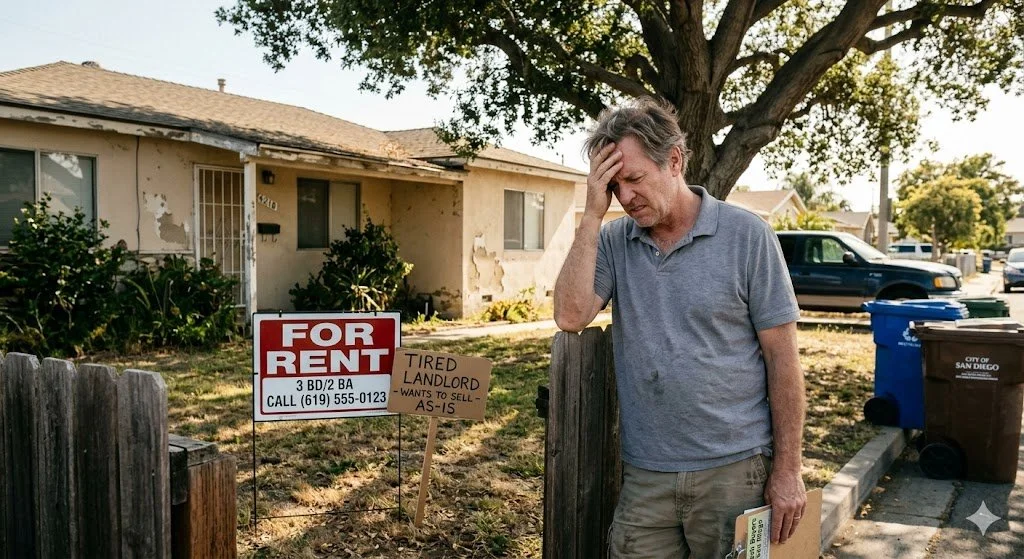
Selling a House with Tenants in San Diego: New 2026 Rules & How to Sell Stress-Free
Your Solution: A Tenant-Occupied Cash Sale
You don't have to wait for the lease to expire or go through a costly "Cash for Keys" negotiation. At Cash Buyers San Diego, we specialize in buying tenant-occupied properties.
We inherit the tenants: You don't have to issue a single notice.
No professional cleaning required: We’ve bought rentals in every condition imaginable.
Discreet and respectful: We work with your tenants to ensure a smooth transition without the "Open House" circus.
Being a landlord in San Diego has changed significantly in 2026. Between the new AB 628 appliance mandates (requiring landlords to provide and maintain refrigerators/stoves) and the strict San Diego Tenant Protection Ordinance, many owners are finding that the "passive income" dream has turned into a compliance nightmare.
If you are looking to sell a rental property in North County or the City of San Diego, you may feel "stuck" between a lease agreement and a tenant who doesn't want to move. Here is what you need to know about your options in today’s market.
1. The "Tenant Protection" Barrier
In the City of San Diego, "Just Cause" eviction protections now often kick in from Day 1 of a lease. This means you cannot simply ask a tenant to leave because you want to sell. If you plan to sell to a retail buyer who wants to live in the home, you may be required to pay 2 to 3 months of relocation assistance (depending on the tenant's age or disability status).
2. The Habitability Trap (AB 628)
As of January 1, 2026, California law considers a unit without a working stove or refrigerator legally uninhabitable. If your rental needs repairs and you try to sell it traditionally, a tenant can use "habitability defenses" to stall the sale or even halt rent payments while the home is on the market.
3. Why Retail Buyers Avoid Tenanted Properties
Most families buying in San Diego today are using FHA or VA loans, which require them to move into the home within 60 days. If your tenant has 6 months left on their lease, 90% of your buyer pool is instantly disqualified. This often leads to your property sitting on the market for months, forcing you to drop the price.
| The Challenge | Selling on the MLS | Selling to Cash Buyers SD |
|---|---|---|
| Tenant Cooperation | Must coordinate dozens of showings | One private walkthrough |
| Relocation Fees | You pay $5k - $15k+ to move tenant | We take over the lease |
| Repairs (AB 628) | Must fix appliances/habitability | Buy As-Is (We handle repairs) |
| Lease Terms | Buyer must honor existing lease | We honor the lease or buy it out |
| Cleaning/Junk | Must be "show-ready" | Leave it in any condition |
Your Solution: A Tenant-Occupied Cash Sale
You don't have to wait for the lease to expire or go through a costly "Cash for Keys" negotiation. At Cash Buyers San Diego, we specialize in buying tenant-occupied properties.
We inherit the tenants: You don't have to issue a single notice.
No professional cleaning required: We’ve bought rentals in every condition imaginable.
Discreet and respectful: We work with your tenants to ensure a smooth transition without the "Open House" circus.
5 Things to Know Before Selling an Inherited House in San Diego
Inheriting a family home in San Diego is often a bittersweet experience. While it’s a generous gift, it frequently comes with a mountain of logistical challenges—especially if the home hasn't been updated since the 1970s or is filled with a lifetime of belongings.
Before you stick a "For Sale" sign in the yard of a San Diego probate property, here are five critical things to consider:
San Diego Inherited Home
Inheriting a family home in San Diego is often a bittersweet experience. While it’s a generous gift, it frequently comes with a mountain of logistical challenges—especially if the home hasn't been updated since the 1970s or is filled with a lifetime of belongings.
Before you stick a "For Sale" sign in the yard of a San Diego probate property, here are five critical things to consider:
1. Understand the Tax Implications (Prop 19)
In California, Prop 19 changed the rules for inherited properties. Unless you plan to move into the home as your primary residence within a year, the property taxes will likely be reassessed at current market values. For a longtime family home, this could mean a tax bill that jumps from $2,000 a year to $12,000 a year.
2. The "Junk" Factor is Real
The biggest hurdle for most heirs isn't the paperwork—it's the stuff. Deciding what to do with decades of furniture, clothes, and memories is emotionally and physically exhausting. Many families spend thousands on dumpsters and weeks of labor just to get the house "broom clean" for a traditional listing.
3. Traditional Buyers Want "Turn-Key"
Today’s San Diego buyers are often maxing out their budgets just to make a down payment. They rarely have an extra $100k to fix a roof, update a kitchen, or replace old cast-iron plumbing. If the inherited home has "deferred maintenance," it will likely sit on the market while you continue to pay insurance, utilities, and taxes.
4. Full Disclosure is Mandatory
In California, you are legally required to disclose known material defects. If you haven't lived in the house for 30 years, you might not know about the slab leak or the termite damage in the attic. This can lead to stressful "re-negotiations" or lawsuits after the sale if not handled correctly.
5. You Have a "Private" Sale Option
You don't have to go through the public circus of an MLS listing. Selling to a local cash buyer like Cash Buyers San Diego allows you to:
Leave the Junk Behind: We handle the entire clean-out.
Sell As-Is: No repairs, no inspections, no surprises.
Close Fast: Get the inheritance proceeds to the family in as little as 7–14 days.
Inherited a "Project" House? Don't spend your weekends hauling junk or managing contractors. We specialize in buying inherited properties across San Diego County in any condition.

Why Your San Diego Home Didn't Sell (And How to Fix It Without Spending a Dime)
It’s a frustrating position to be in. You’ve had your home on the market for 60 days, endured dozens of "looky-loo" open houses, and maybe even dropped your price—yet you’re still sitting on an active listing with no serious offers.
In a competitive market like San Diego, houses usually sell fast. If yours isn't, it’s rarely just "bad luck." Usually, it’s one of these four specific barriers. Here is why your home didn't sell and how to pivot your strategy today.
In a competitive market like San Diego, houses usually sell fast. If yours isn't, it’s rarely just "bad luck." Usually, it’s one of these four specific barriers. Here is why your home didn't sell and how to pivot your strategy today.
1. The "Bank-Ready" Barrier
Most buyers in San Diego are using FHA or VA loans. These government-backed loans have strict Minimum Property Requirements (MPRs). If your home has peeling paint, a roof with less than two years of life, or outdated electrical, the buyer’s bank will literally refuse to fund the loan. You aren't just fighting the buyer; you're fighting their lender.
2. The "Renovation Math" Doesn't Add Up
Today’s buyers are stretched thin by high interest rates. They often don't have the $50,000–$100,000 in cash required to fix a "fixer-upper" after making a down payment. If your home needs a new HVAC system, a kitchen overhaul, or foundation work, retail buyers will skip your listing in favor of a "turn-key" home, even if your price is lower.
3. The "Inconvenience" Factor
Selling a home the traditional way is an invasive process. If you have tenants, pets, or a busy work schedule, the constant demand for "last-minute showings" makes life miserable. Often, homes don't sell simply because they aren't accessible enough for the "golden window" of the first 21 days on market.
4. "Hidden" Inspection Deal-Breakers
In San Diego, we deal with specific local issues: salt-air corrosion in Oceanside, foundation settling in La Mesa, or termite damage in North Park. If a buyer gets a "scary" inspection report, they will almost always back out or demand a massive price credit that kills your equity.
How to Fix It (Without Spending a Dime)
If you don't have the time, desire, or cash to renovate your home just to please a picky buyer, you have a better option.
Stop chasing the market and let the market come to you.
At Cash Buyers San Diego, we specialize in the properties that "traditional" agents struggle to sell. When you sell to us, you bypass the biggest hurdles:
No Banks: We use our own cash, so there are no FHA/VA inspections.
No Repairs: We buy your house exactly as it sits—leaky roof, old carpet, and all.
No Showings: You deal with one buyer (us), one time.
No Commissions: You keep the 6% that would have gone to an agent.
Tired of waiting for an offer?
If your listing has expired or you're tired of the "open house" grind, get a guaranteed cash offer today. No strings attached, no repairs needed.
How to Sell a San Diego House in Probate: A Step-by-Step Guide for Executors
Losing a loved one is hard enough without the added stress of the San Diego Superior Court system. Here's how a probate sale works in San Diego, step by step.
Losing a loved one is hard enough without the added stress of the San Diego Superior Court system. If you’ve been named the Executor or Administrator of an estate, you’ve likely realized that selling "Probate Property" isn't as simple as sticking a sign in the yard.
Between court confirmations, independent appraisals, and the dreaded "junk removal" phase, the process can take anywhere from 6 to 12 months. Here is a breakdown of how the process works in San Diego and how you can simplify it.
1. Granting of "Letters" and Authority
Before you can sign anything, the court must issue Letters Testamentary or Letters of Administration. This gives you the legal authority to act on behalf of the estate.
Pro Tip: In 2026, many estates qualify for the Independent Administration of Estates Act (IAEA), which allows you to sell the home without a specific court hearing for every decision.
2. The 90% Valuation Rule
In California, if the court is supervising the sale, the house cannot be sold for less than 90% of its appraised value (established by a court-appointed Probate Referee). This is why many probate listings sit on the market—they are often priced higher than their actual "as-is" condition warrants.
3. Dealing with "The Contents"
This is usually the most draining part for San Diego families. Estates often contain 40+ years of belongings.
Traditional Path: You hire a junk removal service ($3,000+), an estate sale company (takes 35% of proceeds), and a cleaning crew.
The Cash Path: You take the photos and heirlooms you want, and leave everything else. We handle the heavy lifting, the donation runs, and the dumpsters.
4. Avoiding the "Court Confirmation" Circus
A traditional probate sale often requires a "Confirmation Hearing" where the judge invites "Overbids" in open court. This can be intimidating and often causes original buyers to walk away.
We specialize in buying probate homes privately, often bypassing the need for public overbidding if the estate has "Full Authority" under the IAEA.
The Probate Timeline: A Quick Glance
| Step in Process | Traditional Market Listing | Cash Buyers San Diego |
|---|---|---|
| Legal Authority | Must wait for court-issued Letters | Must wait for court-issued Letters |
| Property Prep | Months of cleaning & repairs | None. We buy 100% "As-Is" |
| Marketing | 30-60 days of public showings | Zero. One private walkthrough |
| Buyer Financing | 30-45 day bank loan approval | None. All-cash transaction |
| Inspections | Full structural & pest inspections | Waived. We take the risk |
| Junk Removal | You must hire crews/dumpsters | Included. Leave what you want |
| Closing Time | 4 - 8 Months (Average) | 7 - 14 Days (Post-Letters) |
Are You the Executor of a San Diego Estate? Don't let a "Fixer-Upper" probate property drag on for months. We work directly with estate attorneys and executors to provide a fast, respectful, and private cash exit. We’ll even handle the clean-out so you don’t have to.